Asian markets besides the Hang Seng and Nikkei
 I recently discovered that there is a correlation between low office/work activity and me taking tentative, virgin steps towards becoming a proper lady who acts her age and away from the heady days of self-flagellation at work during the week and the blur of the Beijing nightlife on weekends. I had until the very recently refused to be tainted by such poppycock as to actually prepare a meal from scratch. But a Christmas present cookbook from Di and somewhat disastrous patch at work resulting in quite a bit of time to spare convinced me that I should at least give this cooking business a go. So, after a leisurely lunch on Saturday afternoon I tagged along with D&D to the fresh produce market in Xinyuanli, not too far off from the Sanlitun Diplomatic Area.
Anyone who's ever been to an Asian market before will know that it is not the most pleasant experience and has been known to turn even the most voracious carnivores into PETA activists. They are a far cry away from sterile supermarket aisles bathed in warm light and individually plastic-wrapped cuts of meat without any hint as to their original hosts. I attribute my herbivorism to two individual visits to Asian markets. The first was a good few years ago when I was back in Kuala Lumpur for the summer holidays. My mother brought me to visit the chicken seller who has supplied the Chan family with our poultry for as long as I can remember. I can't recall her name, it was something generic in Cantonese: Ah Chan, or Ah Mei, or Ah Fong. In any case, we also called her Gai Poh which means Chicken Lady in Cantonese. I recall standing awestruck at her stall, watching her Indonesian hires (a further sign of the forward march of market forces: even the Gai Poh at Pudu Wetmarket has gone global) perform systematic slaughter of sickly battery chickens, living the last moments of their miserable lives with necks poking out of plastic crates, witnessing their own fate through fellow crate-dwellers. Two workers stood on either side of a column of plastic crates stacked about 6 high full of chickens. There was a small opening on the top from which one worker would reach in, grab a bird, snap its neck back, slit its neck and then promptly throw the bird - airborne and still squawking - into a cauldron of boiling water, feathers, blood and dying chickens still feebly flapping their half bald scalded wings against the side of the cauldron, which was really just an old rusty oil drum . The two workers would take turns killing the chickens and throwing them into the boiling water with such clockwork accuracy that only one chicken would fall at any time so that the other worker whose job was to stir the grim contents with a wooden plank would not be overwhelmed by chickens. The stench of cooking feathers, blood and in all likelihood, feces, was so bad that I had to hold my breath so as not to be sick. After the pristine grocery procurement environs of Sainsburys and Safeway, the reality of where my food came from could not be any harsher. Fast forward a few years to the time I decided to explore a neighbourhood market when I first arrived in Beijing and was living on the the 3rd East Ring Road just south of Panjiayuan. I was rather enjoying myself watching the cartloads of watermelons pulled by donkeys just outside the main gates of the market and old ladies grumbling about the prices of Chinese cabbage. I didn't realise that I had ventured into the meat section of the market and came face to face with a host of decapitated heads displayed on some stalls to identify the kind of meat that was being sold. I can still remember a pair of glazed over eyes staring up at me and a long, purple tongue potruding from one side of the snout from a massive hog's head. It was from that defining moment that I decided that if I couldn't kill it, I wouldn't eat it.
The Xinyuanli market was more similar to the one near Panjiayuan in that there wasn't any actual slaughtering going on. But it still turned my stomach to see goat carcasses splayed open in crucification stance and beef ribs resembling a giant, fleshy xylophone hanging from meat hooks above a variety of bovine innards . Di's first stop was the herb lady where such items as dill, lemon leaves, rocket leaves and mint were procured. While waiting for Di I poked my head next door and bought some galangal and lemongrass.
"What are you cooking with those?"
"Erm... I dunno. Buying them for good luck. Just in case..."
"Just in case what?"
"Just in case, D."
Indeed, everyone can afford some 'good luck' for less than 2 kuai, which was what I paid the herb lady.
I wanted some salmon for dinner so we made our way over to the fishsellers. Now after that tirade anyone would think that I'm vegan and subscribe to that famous Alicia Silverstone one-liner "Milk is mucus". As I said, I don't think it's right to eat anything I can't kill. Although I have never killed a salmon before (I've never actually seen a WHOLE salmon before, never mind alive) but I'm sure I'll manage by flipping it out of the water and waiting for it to die. I know. I'm lame.
The beauty about this particular market in Xinyuanli is that a lot of restaurants in the vicinity source their food from here. The fish chap from whom I bought salmon (market price that day RMB30/jin compared to RMB110/kilo from a supermarket near my flat) boasted that chefs from nearby Japanese restaurants come to him to buy tuna and salmon to make sashimi. The two Ds also purchased a couple of tuna steaks and a red snapper. The fish chap offered to fillet the snapper (I'm stll getting over the fact that he could say 'fillet') and even dished out advice about how best to cook and prepare the fish. It was amusing to watch him give Mr. D, who has handled a fish or two over the course of his illustrious culinary career, a lesson in basic fish cooking and that the secret to tuna steaks in a jiffy was to panfry each side for 5 minutes in olive oil. You'd never get that sort of personal attention in a supermarket, not anywhere in the world.
One of our last stops, and certainly my most reluctant one, was made at the Muslim butcher as Di wanted to some meat for soup. The stall owner, a hefty Hui man in signature white cap, sharpened his knife even as Di looked down her shopping list for the meat she required. Finally, she decided on ribs for meat on bone. The Hui butcher walked over to the aforementioned monstrous beef rib xylophone (I'm a city slicker through and through and somehow convinced myself that beef ribs were only as big as the ones served in Tony Roma's) and hacked off a couple of racks. As they were about a metre long and Di couldn't very well put those in her pot so she asked the Hui butcher to cut them up into more managable pieces. The butcher, happy to oblige, set the ribs down on a huge chopping block which was a round wooden coin-shaped thing sawed off a large tree. What do butchers use to hack bones into small pieces? Not even the traditional cleaver, a favourite with the Chinese around the world, not least Cantonese kitchen workers (if HK kung fu movies are to be believed) would do. The butcher picked up an AXE that was propped up against his stall next to the chopping board, swung it above his head and brought it down with a crack. Crack! Crack! Crunch! The sound of axe against bone, shards of meat and other fleshy matter flying through the air.
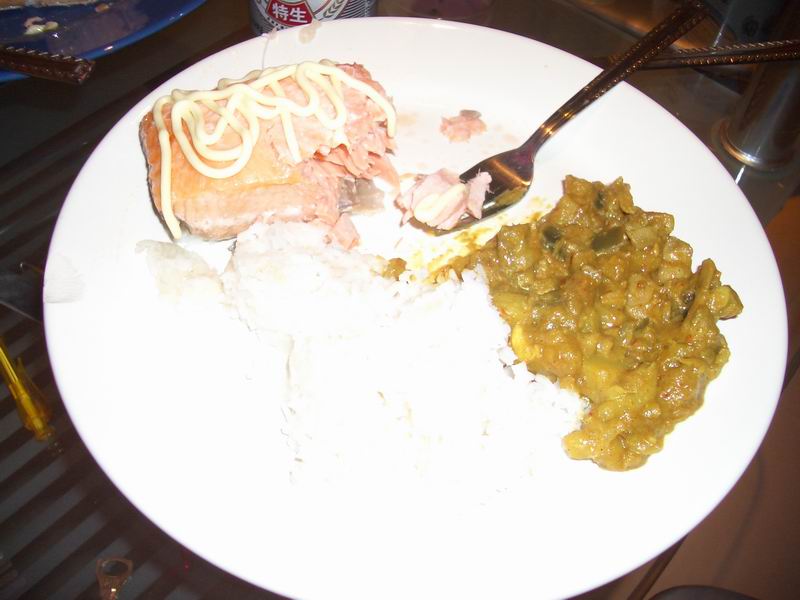
That night I made simple baked salmon and served it with leftover vegetarian curry and rice. The results...
 Looking very pleased with myself (and secretly hoping that I wasn't about to give Max a violent bout of food poisoning)
Leading by example and diving into dinner.
 Max gives the thumbs up to the first ever non microwavable TV dinner he's had at my home.
posted by Jo at 8:19 PM
1 comments